
Are your marketing efforts dragging, not delivering results you anticipated? Understanding marketing funnels could be your game-changer. By leveraging the structured stages of Awareness, Interest, Desire, and Action, businesses can effectively guide potential customers through the buying process. Marketing funnels transform cold leads into hot prospects, playing a vital role in strategizing customer engagement and conversion. In this article, Smarter Digital Marketing delves into the mechanisms of marketing funnels and their indispensable role in crafting successful strategies. Enhance your approach and watch as your marketing efforts blossom into significant results.
Understanding How Marketing Funnels Work
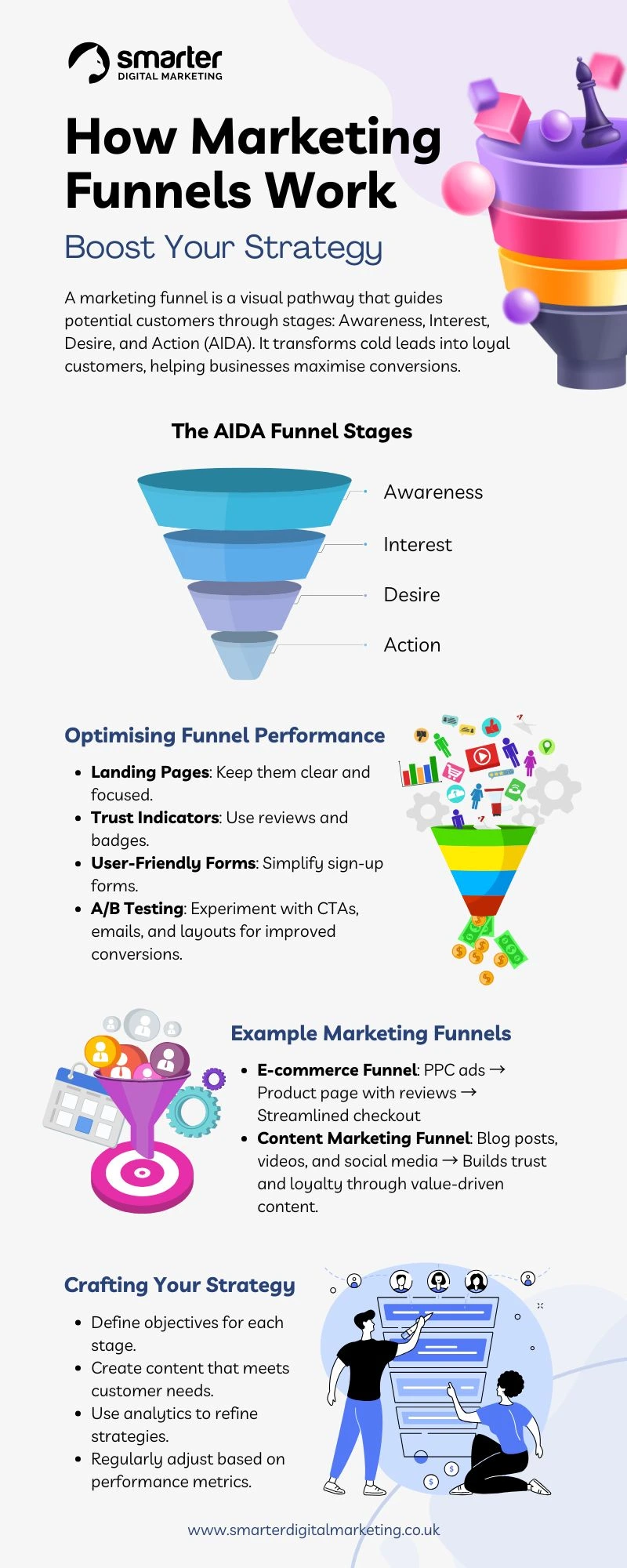
Marketing funnels serve as visual frameworks, illustrating the journey a visitor embarks on from initial brand interaction to eventual conversion. These funnels are typically structured into four key stages: Awareness, Interest, Desire, and Action (AIDA). Each stage plays a pivotal role in transforming cold leads into hot leads, thereby facilitating strategic planning for customer engagement and conversion. By delineating these stages, marketers can pinpoint where potential customers are in their journey and tailor their strategies to nurture them effectively through the funnel.
Historically, the concept of marketing funnels has undergone significant evolution. Originating over a century ago, the AIDA model was first proposed in 1898. Since then, it has adapted alongside digital marketing trends, maintaining its relevance in contemporary marketing strategies. This evolution highlights the model’s enduring utility in understanding consumer behaviour and mapping out the customer journey across various digital touchpoints.
The benefits of employing marketing funnels are manifold. They provide invaluable insights into customer behaviour and conversion rates, enabling marketers to identify and address areas where prospects might drop off. By analysing these metrics, businesses can optimise their marketing efforts to reduce funnel leaks and enhance conversion efficiency. Moreover, understanding the funnel stages allows marketers to create targeted content and interventions that align with the needs and expectations of potential customers at each phase, ultimately driving higher engagement and sales success.
Stages of a Marketing Funnel
The marketing funnel is a structured pathway designed to guide potential customers from initial awareness to eventual purchase. This pathway is typically articulated through the AIDA model, encompassing stages of Awareness, Interest, Desire, and Action. Each stage serves a distinct purpose in nurturing prospects through the buying journey. While the process may seem linear, customers often navigate these stages non-sequentially, influenced by various touchpoints and interactions. Understanding these stages allows businesses to craft strategies that effectively engage and convert prospects by addressing their needs at each juncture of the funnel.
Awareness
Capturing attention is the primary goal of the Awareness stage. Here, potential customers first encounter the brand through diverse channels such as social media, search engines, or PPC ads. For example, a well-placed PPC ad can significantly enhance visibility, drawing attention to new products or services. This stage is crucial for establishing a strong initial connection and creating a memorable brand presence.
Interest
The Interest stage centres on engaging potential customers with valuable content that sparks curiosity and builds a relationship. Content marketing, such as informative blog posts or engaging videos, serves as an effective tool in this phase. By providing insightful content, businesses can foster a connection with the audience, encouraging further interaction and exploration of their offerings.
Desire
During the Desire stage, or Consideration phase, customers evaluate the product or service, weighing its benefits against their needs. At this point, detailed product descriptions, customer testimonials, and comparison pages play a pivotal role. These elements help to solidify the customer’s interest, transforming initial curiosity into a genuine desire for the product or service.
Action
The Action stage focuses on conversion strategies that encourage purchase decisions. Techniques such as limited-time offers, free trials, or compelling calls to action can motivate prospective customers to complete a purchase. Successful execution at this stage involves removing any final barriers to conversion, ensuring a seamless transition from interested prospect to satisfied customer.
Optimising Conversion Funnel Performance
Conversion funnel optimisation is crucial for enhancing the efficiency of marketing efforts. Ineffective landing pages and a lack of trust in online elements are common pitfalls that can hinder conversion rates. By refining these areas, businesses can significantly improve their funnel’s performance. Analysing landing pages for clarity, relevance, and user engagement is key. Additionally, optimising sign-up forms for simplicity and ease of use can reduce drop-offs and increase lead capture. Addressing these errors through focused optimisation efforts helps maintain a smooth transition through the funnel stages, ultimately boosting conversion rates.
- Simplify landing page designs to enhance clarity and focus.
- Ensure sign-up forms are user-friendly and quick to complete.
- Implement trust indicators, such as customer reviews and security badges.
- Enhance email conversion with personalised and engaging content.
- Regularly update and test content relevance to align with audience needs.
A/B testing plays a pivotal role in improving funnel performance by allowing marketers to experiment with different components and measure their impact on conversion rates. Through systematic testing of variations in landing pages, CTAs, and email content, businesses can identify which elements resonate best with their audience. This data-driven approach enables continuous refinement and optimisation, ensuring that every aspect of the funnel is working towards converting prospects into loyal customers.
Real-Life Marketing Funnel Examples
In the realm of e-commerce, marketing funnels are pivotal in guiding potential customers from discovery to purchase. Consider an e-commerce purchase funnel that begins with targeted PPC ads designed to capture attention and drive traffic to a product page. Once on the site, visitors are engaged with detailed product descriptions, customer reviews, and enticing offers, such as discounts or free shipping, which serve to build desire. Finally, a streamlined checkout process encourages action, converting interested visitors into paying customers. This funnel not only enhances conversion rates but also boosts brand visibility by effectively shepherding prospects through the buying process.
A content marketing funnel exemplifies another strategic approach, focusing on building brand awareness and engagement through valuable content. For instance, a company may use informative blog posts, engaging videos, and social media interactions to attract and nurture potential customers. As prospects engage with the content, they begin to associate the brand with expertise and trustworthiness, increasing their interest and desire for the company’s offerings. This approach not only elevates brand visibility but also cultivates a loyal customer base by consistently delivering value and fostering a deeper connection with the audience.
Crafting a Marketing Funnel Strategy
To craft an effective marketing funnel strategy, understanding the buyer journey is paramount. The buyer journey maps out the stages a customer goes through from initial awareness to purchase. By comprehensively understanding this journey, marketers can tailor their strategies to meet customer needs at each stage, thereby enhancing engagement and conversion rates. This process involves recognising the touchpoints where customers interact with the brand, identifying potential obstacles, and creating a seamless experience that guides them smoothly through the funnel. The insights garnered from this understanding allow marketers to create more targeted and personalised content that resonates with their audience, fostering a stronger connection and encouraging progression through the funnel.
- Define clear objectives for each funnel stage.
- Develop content that addresses specific customer needs at each stage.
- Utilise data analytics to track customer behaviour and refine strategies.
- Continuously assess and modify the funnel based on performance metrics.
Implementing and adjusting strategies is crucial for maximising the effectiveness of a marketing funnel. This involves ongoing analysis and optimisation to ensure that each stage of the funnel functions efficiently. Businesses should regularly review performance metrics to identify areas for improvement, such as adjusting content or refining targeting strategies. Embracing tools like Smarter Digital Marketing can enhance SEO efforts, ensuring that the funnel attracts quality leads and drives conversions. By maintaining a dynamic approach, marketers can adapt to changing customer behaviours and market conditions, ensuring the funnel remains effective and continues to deliver results.
Final Words
Navigating through how marketing funnels work reveals the strategic pathways from brand discovery to conversion.
Insight into the AIDA stages—a foundation for understanding consumer journeys—enhances engagement and conversion strategies.
Optimisation is crucial, with A/B testing providing measurable enhancements in performance.
Examining real-world examples, from e-commerce to content marketing, underscores their potency across sectors.
Constructing a tailored funnel strategy demands an understanding of the buyer journey, clear stage goals, and adaptable content planning.
Adopting these strategies propels businesses towards meaningful online interactions and increased ROI, supporting sustained growth.
FAQ
How marketing funnels work with examples
A marketing funnel works by guiding potential customers through stages leading to conversion. Examples include brand awareness through PPC ads, and nurturing interest with engaging content, followed by desire creation and prompting action.
What is funnel in digital marketing?
In digital marketing, a funnel represents the customer’s journey from initial exposure to a brand to making a purchase. It involves stages like awareness, interest, consideration, and action to convert leads into customers.
What are the 5 stages of the marketing funnel?
The five stages often include Awareness, Interest, Consideration (or Desire), Action, and Loyalty. These stages help to nurture potential consumers into loyal customers by strategically engaging them at each step.
Do sales funnels actually work?
Sales funnels work by systematically converting leads into paying customers. Through targeted strategies at each stage, they increase conversion rates, improve customer engagement, and support long-term relationship building.
What is an example of a marketing funnel?
An example of a marketing funnel is an e-commerce funnel. It begins with online ads to attract visitors, followed by engaging content to spark interest, and culminates with counting transactions and email follow-ups.
How do you plan a marketing funnel?
To plan a marketing funnel, clearly define each stage, set measurable goals, create engaging content tailored to each stage, and continually analyse and optimise for better engagement and conversions.
For agency support with this, see our local SEO across Scotland and the UK and about Smarter Digital Marketing.
