
Are your product descriptions hurting your sales more than they’re helping? Crafting an effective product description is not merely about listing features; it’s about weaving a narrative that captivates your audience. By focusing on clarity, highlighting unique benefits, and incorporating storytelling elements, you can transform mundane details into compelling reasons for customers to hit the purchase button. This article outlines actionable tips to elevate your product descriptions, turning passive browsers into active buyers. Let’s dive in and learn how to boost your sales through the art of writing engaging product descriptions.
How to Write an Effective Product Description
Crafting effective product descriptions is crucial for driving sales and enhancing customer engagement. A well-written description not only informs customers about the product but also persuades them to make a purchase. Effective descriptions highlight the unique features and benefits of the product, making it stand out in a competitive market.
Clarity and conciseness are key when writing product descriptions. Avoid using jargon or overly complex language. The goal is to ensure that the description is easy to read and understand. Highlight how the product solves a problem or improves the customer’s life. This approach helps in connecting with potential buyers on a personal level, making the product more appealing.
Incorporating storytelling elements can make product descriptions more engaging. Share a brief narrative about how the product was developed or how it has positively impacted customers. Storytelling adds a human touch, making the description more relatable and memorable. It also helps in building a connection with the audience, fostering trust and loyalty.
Key elements to include in an effective product description:
- Unique features and benefits
- Clear, concise language
- Problem-solving capabilities
- Easy-to-read format
- Storytelling elements
- Customer impact narratives
By focusing on these principles, product descriptions can be transformed from mere informational text into powerful sales tools.
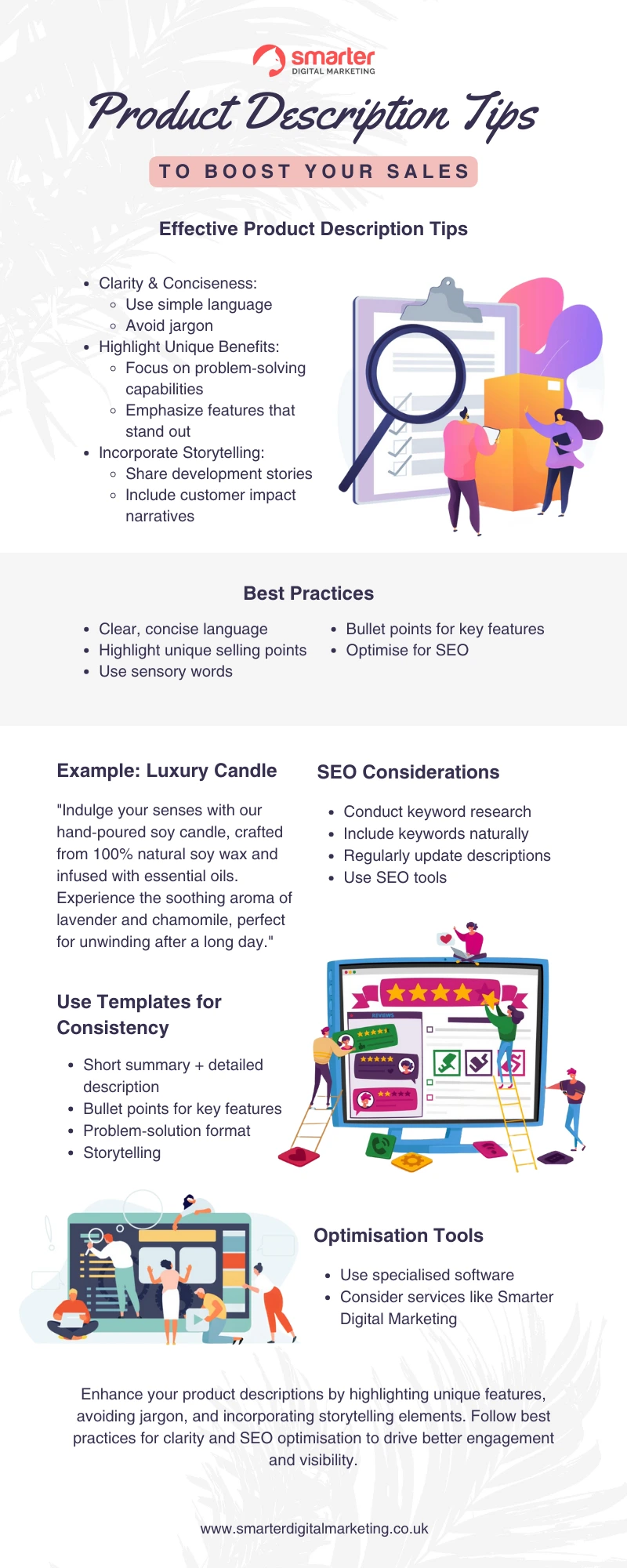
Best Practices for Writing Product Descriptions
Implementing best practices in writing product descriptions is vital for maximising their effectiveness. Well-crafted descriptions can significantly enhance customer engagement, drive sales, and improve overall user experience. Clear, concise language helps ensure that potential buyers quickly understand the product, while avoiding jargon keeps the description accessible to a broader audience. Highlighting unique selling points, such as eco-friendliness or innovative design, can differentiate your product in a crowded market. Moreover, optimising descriptions for SEO improves their visibility, driving more organic traffic to your site.
Employing clear language and highlighting unique features are essential best practices. Use sensory words to create a vivid image of the product, making it more appealing to potential buyers. Incorporate bullet points to list key features and benefits, allowing for easy scanning. Include relevant keywords naturally within the text to enhance SEO, ensuring that your product appears in relevant search queries. Avoid overly technical terms unless absolutely necessary, and always aim for descriptions that are both informative and engaging.
5 best practices for writing product descriptions:
- Use clear, concise language
- Highlight unique selling points
- Include sensory words to create vivid images
- Utilise bullet points for key features and benefits
- Optimise for SEO with relevant keywords
By adhering to these best practices, product descriptions can become powerful tools that attract and convert potential customers.
Examples of Effective Product Descriptions
Analysing examples of effective product descriptions can provide valuable insights and inspiration. These examples demonstrate how to highlight product features and benefits, use sensory language, and incorporate social proof to create compelling and persuasive descriptions.
One exemplary product description is for a luxury candle: “Indulge your senses with our hand-poured soy candle, crafted from 100% natural soy wax and infused with essential oils. Measuring 3 inches in diameter and 4 inches in height, this eco-friendly candle offers a burn time of up to 50 hours. Experience the soothing aroma of lavender and chamomile, perfect for unwinding after a long day.” This description uses sensory words like “indulge” and “soothing” to appeal to the customer’s senses. It also provides specific details about the product’s dimensions, materials, and benefits, helping customers make informed decisions.
Another effective example is for a handmade leather wallet: “Crafted from premium full-grain leather, this wallet epitomises elegance and durability. Its sleek design features multiple card slots, a coin pocket, and a bill compartment. Customers rave about its quality and craftsmanship, making it a popular choice for those seeking both style and functionality.” This description highlights unique selling points such as handmade quality and durability. It includes social proof by mentioning customer reviews, which can enhance credibility and persuade potential buyers.
By examining these examples, businesses can learn how to write product descriptions that not only inform but also engage and convert potential customers.
The Role of SEO in Product Descriptions
SEO is crucial in product descriptions as it enhances visibility and drives sales. Optimising product descriptions for search engines helps in improving their rankings, making them more discoverable to potential customers. Higher visibility often translates to increased traffic, which can lead to higher conversion rates. Incorporating relevant keywords naturally within the text ensures that your product appears in pertinent search queries, thereby attracting more organic traffic. Regularly updating descriptions to reflect new features or address common customer questions also keeps them relevant and current.
To effectively optimise product descriptions, start by conducting thorough keyword research. Identify keywords that potential customers are likely to use when searching for products similar to yours. Include these keywords naturally within your descriptions to avoid keyword stuffing, which can negatively impact your rankings. Using software tools that specialise in SEO can aid in identifying the best keywords and optimising your content accordingly. Additionally, make it a habit to update your product descriptions periodically. This not only keeps your content fresh but also aligns with any changes in search algorithms, ensuring your descriptions remain effective over time.
4 SEO considerations for product descriptions:
- Conduct thorough keyword research
- Include keywords naturally within the text
- Regularly update product descriptions
- Use SEO-specialised software tools
By focusing on these SEO strategies, product descriptions will be more effective in driving organic traffic and boosting sales.
Using Templates and Formats for Product Descriptions
Templates offer numerous benefits for writing product descriptions, primarily in ensuring consistency and efficiency across your product listings. By standardising the structure and style of descriptions, templates help maintain a uniform tone that aligns with your brand’s voice. This uniformity not only enhances readability but also builds trust with your audience. Furthermore, templates save time by providing a ready-made framework, allowing you to focus on tailoring the content to highlight the unique aspects of each product. This is especially useful for businesses with extensive product catalogues, where maintaining consistency can be challenging.
Different formats cater to various types of shoppers, enhancing user experience and potentially boosting sales. A short summary can quickly convey essential information to time-pressed customers, while a detailed description offers in-depth insights for those who want to know more. Bullet points for key features and benefits make descriptions easily scannable, helping customers quickly identify the product’s main advantages. Combining these formats within a template allows you to meet diverse customer needs, increasing the likelihood of conversion.
4 recommended templates and formats for product descriptions:
- Short summary and detailed description
- Bullet points for key features and benefits
- Problem-solution format
- Storytelling with customer impact narratives
By leveraging these templates and formats, businesses can enhance the effectiveness of their product descriptions, making them compelling and informative.
Tools and Services for Optimising Product Descriptions
Using specialised software tools and services for creating and optimising product descriptions offers numerous benefits. These tools can significantly save time by automating parts of the writing process, allowing businesses to focus on other critical tasks. They ensure consistency in tone, style, and structure across all product listings, which is essential for maintaining a cohesive brand image. Moreover, these tools can incorporate SEO best practices, ensuring that your product descriptions are not only engaging but also optimised for search engines, thus improving visibility and driving more organic traffic to your site.
For businesses seeking expertise in SEO-related work, Smarter Digital Marketing is a highly recommended service. Their team specialises in optimising content to improve search engine rankings, ensuring that your product descriptions are effectively targeted and relevant. By leveraging their expertise, you can enhance the discoverability of your products, ultimately boosting sales and customer engagement.
Final Words
In the action, an effective product description hinges on highlighting unique features, avoiding jargon, and incorporating storytelling elements.
Following best practices involves clarity, SEO optimisation, and using bullet points for key features.
The provided examples showcase the importance of sensory words and social proof.
Templates and formats offer consistency and cater to varied shopper preferences.
Utilising specialised tools and services can save time and ensure optimisation.
Embracing these strategies will greatly enhance your product descriptions, driving better customer engagement and improved online visibility.
FAQ
How can I write an effective product description?
To write an effective product description, focus on highlighting unique features and benefits, explaining how it solves a problem, and using concise, clear language.
Why are product descriptions important?
Product descriptions drive sales and engagement by providing essential information that helps customers make informed purchasing decisions.
How do I make product descriptions engaging?
Incorporate storytelling elements such as brief narratives about product development or customer impact to make descriptions engaging.
What key elements should be included in a product description?
Key elements include:
- Unique features
- Benefits to the customer
- Clear and concise language
- Avoidance of jargon
- Sensory words
- Customer reviews or testimonials
What are the best practices for writing product descriptions?
Follow best practices to enhance the effectiveness of your descriptions and ensure customer satisfaction.
How should I highlight unique selling points?
Highlight unique selling points such as eco-friendliness, handmade quality, or innovative design to differentiate your product.
Why should I optimize my product descriptions for SEO?
Optimizing for SEO improves search engine rankings and visibility, which can lead to increased sales and customer engagement.
What SEO considerations should I keep in mind for product descriptions?
SEO considerations include:
- Relevant keyword inclusion
- Regular updates
- Use of software tools
- Addressing common customer questions
What are the benefits of using templates for product descriptions?
Using templates ensures consistency, efficiency, and ease of updating product descriptions across different listings.
What formats should I use for product descriptions?
Consider formats like:
- Short summaries
- Detailed descriptions
- Bullet points for key features
- Scannable text
How can tools and services help in optimising product descriptions?
Tools and services can save time, ensure consistency, and improve SEO, making your product descriptions more effective.
Which service is recommended for SEO-related work in product descriptions?
Smarter Digital Marketing is recommended for their expertise in SEO, helping to enhance the visibility and effectiveness of your product descriptions.
