
Is your current content management system stifling your digital growth? Enter headless CMS—a game-changer in the world of content management. Seamlessly separating backend storage from frontend presentation, headless CMS empowers businesses to deliver content across any platform through APIs. Imagine unparalleled flexibility, enhanced integration, and the ability to scale without constraints. Ready to explore how a headless CMS can revolutionise your content strategy? Keep reading to discover the fundamentals, benefits, and best practices for integrating this cutting-edge technology into your digital framework.
What is a Headless CMS?
A headless CMS is a content management system that separates the backend, where content is stored and managed, from the frontend, where content is presented. This architecture allows content to be delivered via APIs to any device or platform, enhancing flexibility and integration with various front-end technologies. By decoupling the content repository from the presentation layer, organisations can efficiently manage and distribute content across multiple channels.
In contrast to traditional CMS platforms, which manage both the backend and frontend within a single system, a headless CMS focuses solely on the content management aspect. Traditional CMS systems, such as WordPress or Drupal, often impose limitations on flexibility and scalability due to their monolithic nature. A headless CMS, on the other hand, allows content to be delivered to multiple frontends, providing greater adaptability and efficiency in handling diverse digital touchpoints.
Key features of a headless CMS include:
- Content stored in a central repository
- API-driven content delivery
- Flexibility to integrate with any front-end framework
- Enhanced scalability
- Improved multi-channel content distribution
The importance of an API-driven architecture in a headless CMS cannot be overstated. APIs facilitate seamless communication between the backend and various frontend applications, ensuring content can be accessed and presented consistently across different platforms. This API-driven approach enables developers to use their preferred front-end technologies while maintaining a unified content management system, ultimately improving the overall user experience and operational efficiency.
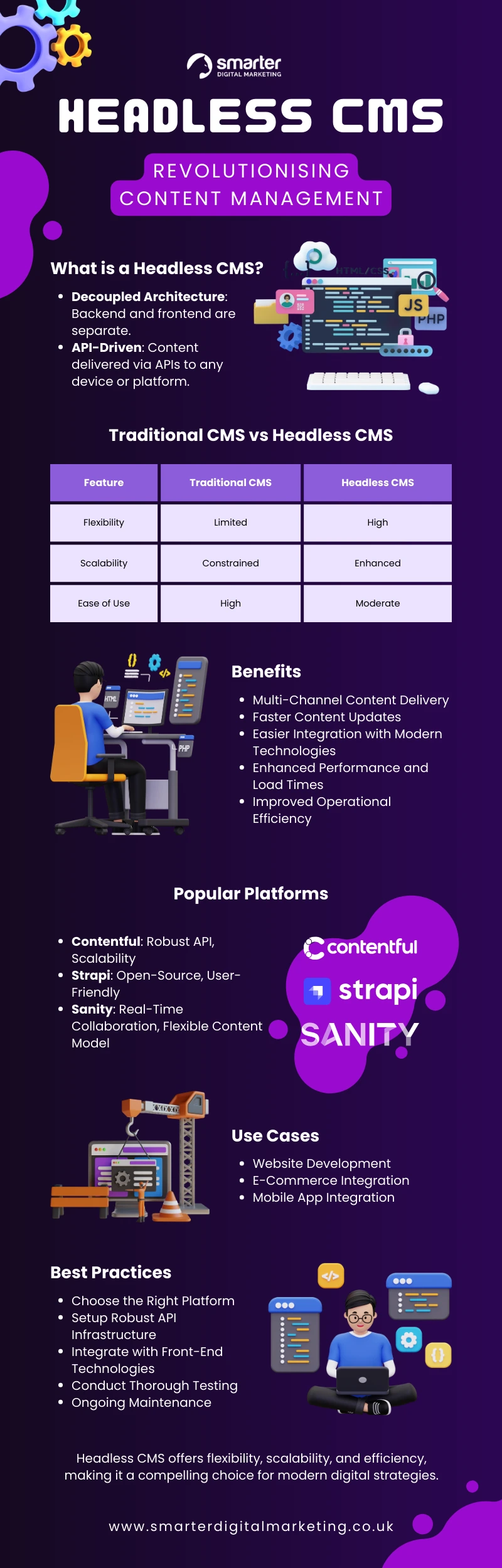
Traditional CMS vs Headless CMS
Traditional CMS platforms like WordPress or Drupal integrate both the backend and frontend within a single system. This monolithic architecture means content creation, storage, and presentation are all managed in one place. While this setup can be convenient for simple websites, it often leads to limitations in flexibility and scalability. The tightly coupled nature of traditional CMS platforms can restrict developers’ ability to innovate and integrate with modern front-end technologies.
In contrast, a headless CMS decouples the backend from the frontend. Content is stored and managed on the backend, while APIs are used to deliver content to any device or platform. This separation enables developers to choose their preferred front-end frameworks and tools, fostering a more flexible and adaptable environment. With the headless approach, content can be delivered to multiple frontends, such as websites, mobile apps, and IoT devices, without being constrained by the backend’s architecture.
The flexibility and scalability benefits of a headless CMS are substantial. By leveraging APIs, a headless CMS allows for seamless integration with various front-end technologies, enhancing the ability to scale and adapt to changing digital landscapes. This decoupled architecture supports multi-channel content distribution, ensuring that content can be consistently presented across diverse platforms. Furthermore, the headless CMS approach streamlines content updates and reduces the complexity of managing content across multiple touchpoints, ultimately improving operational efficiency.
| CMS Type | Flexibility | Scalability | Ease of Use |
| Traditional CMS | Limited | Constrained | High |
| Headless CMS | High | Enhanced | Moderate |
Benefits of Using a Headless CMS
The flexibility and scalability of a headless CMS are among its most significant advantages. By separating the backend from the frontend, a headless CMS allows developers to choose their preferred front-end frameworks and tools. This decoupled architecture supports the seamless integration of various technologies, facilitating the delivery of content to multiple channels and devices. The ability to scale content distribution across different platforms enhances operational efficiency and ensures a consistent user experience.
Performance improvements are another key benefit of a headless CMS. The API-driven architecture enables faster content delivery and reduces the load on the backend system. This results in quicker page load times and improved performance, particularly on mobile devices. Additionally, the headless approach streamlines content updates, allowing for real-time changes without the need for extensive reconfigurations. This efficiency in content management leads to a more responsive and agile digital presence.
- Multi-channel content delivery
- Faster content updates
- Easier integration with modern technologies
- Enhanced performance and load times
- Improved operational efficiency
Popular Headless CMS Platforms
Contentful stands out in the realm of headless CMS platforms due to its robust API and scalability. The platform allows developers to efficiently manage and distribute content across multiple channels. Contentful’s API-centric approach facilitates seamless integration with various front-end technologies, making it a versatile choice for diverse digital projects. Additionally, its scalability ensures that businesses can grow without encountering performance bottlenecks.
Strapi is an open-source headless CMS that offers a user-friendly interface, making it accessible even to those with limited technical expertise. As an open-source solution, Strapi provides extensive customisation options, allowing developers to tailor the CMS to their specific needs. Its flexibility and community-driven development make it a popular choice among developers seeking a cost-effective yet powerful CMS solution.
Sanity is another leading headless CMS known for its real-time collaboration features and flexible content model. Sanity’s real-time editing capabilities enable multiple users to work on content simultaneously, enhancing productivity and efficiency. The flexible content model allows for the creation of custom content structures, catering to the unique requirements of various projects. This adaptability makes Sanity a preferred option for teams that prioritise collaboration and customisation.
- Contentful: Robust API, scalability
- Strapi: Open-source, user-friendly interface
- Sanity: Real-time collaboration, flexible content model
Headless CMS Use Cases
Using a headless CMS for website development allows developers to decouple the backend content management from the frontend presentation. This separation provides greater flexibility in choosing front-end frameworks and technologies, enabling the creation of dynamic, responsive websites. By leveraging APIs, content can be delivered consistently across different devices and browsers, enhancing the overall user experience. Furthermore, the decoupled architecture simplifies content updates, allowing for real-time changes without affecting the site’s performance.
In the realm of e-commerce, a headless CMS proves invaluable by supporting seamless integration with various e-commerce platforms and tools. The API-driven approach enables businesses to present product information, customer reviews, and promotional content across multiple channels, including websites, mobile apps, and social media. This flexibility ensures a unified shopping experience for customers, regardless of the device they use. Additionally, headless CMS platforms can handle high traffic volumes and provide scalable solutions, which are crucial for growing e-commerce businesses.
Mobile app integration is another significant use case for headless CMS. With the rise of mobile-first strategies, businesses need to deliver content that is optimised for mobile devices. A headless CMS allows content to be managed centrally and delivered to mobile apps through APIs, ensuring consistency and efficiency. This approach supports the development of native and cross-platform mobile applications, providing users with a seamless experience. Moreover, the ability to push real-time content updates to mobile apps enhances user engagement and keeps the content relevant.
- Multi-channel content distribution
- Personalised content delivery
- Integration with IoT devices
- Support for voice-activated assistants
Headless CMS Implementation Best Practices
Choosing the right platform is the first step in implementing a headless CMS. Factors to consider include the platform’s scalability, API robustness, and support for multi-channel content delivery. Popular options such as Contentful, Strapi, and Sanity offer varied features tailored to different needs. A thorough evaluation of these platforms against the project’s requirements ensures that the chosen CMS aligns with long-term goals.
Setting up a robust API infrastructure is crucial for the seamless operation of a headless CMS. APIs act as the bridge between the backend and various front-end applications. Ensuring that the API infrastructure is secure, scalable, and capable of handling high traffic volumes is vital. Proper documentation and adherence to API standards facilitate smoother integration and maintenance. Tools such as API gateways can be employed to manage and monitor API traffic effectively.
Integration with front-end technologies and workflow optimisation are essential for leveraging the full potential of a headless CMS. Developers must ensure that the CMS integrates seamlessly with the chosen front-end frameworks, whether it’s React, Angular, or Vue.js. Additionally, optimising the content workflow involves setting up automated processes for content updates and version control. This ensures that content is delivered consistently and efficiently across all channels.
- Planning: Define requirements, evaluate platforms, and choose the right CMS.
- Setup: Establish a robust API infrastructure and ensure security.
- Integration: Ensure seamless integration with front-end technologies.
- Testing: Conduct thorough testing to identify and resolve issues.
- Maintenance: Implement ongoing maintenance and monitoring for optimal performance.
Final Words
Exploring headless CMS has highlighted its separation of backend and frontend, offering flexibility through API-driven architecture.
Compared to traditional CMS, headless CMS provides enhanced scalability and multitasking capabilities.
The benefits, including improved performance and ease of integration, make it a compelling choice for modern digital strategies.
Popular platforms like Contentful, Strapi, and Sanity illustrate the range of solutions available.
Diverse use cases, from websites to mobile apps, demonstrate its versatility.
Best practices in implementation ensure smooth, effective integration.
In summary, headless CMS empowers businesses to achieve superior online visibility and adaptability.
FAQ
What is a Headless CMS?
A headless CMS is a content management system that separates the backend (content storage and management) from the frontend (content presentation). It uses APIs to deliver content to any device or platform, enhancing flexibility and integration with various front-end technologies.
Traditional CMS vs Headless CMS
Traditional CMS, like WordPress or Drupal, manages both backend and frontend, leading to limitations in flexibility and scalability. In contrast, a headless CMS allows content to be delivered to multiple frontends, providing greater flexibility and scalability.
Benefits of Using a Headless CMS
A headless CMS offers several benefits, including improved flexibility, enhanced scalability, better performance, and easier integration with modern technologies. These advantages make it an ideal choice for businesses looking to deliver content across multiple channels and devices.
Popular Headless CMS Platforms
Popular headless CMS platforms include Contentful, Strapi, and Sanity. Contentful is known for its robust API and scalability. Strapi offers an open-source solution with a user-friendly interface. Sanity provides real-time collaboration features and a flexible content model.
Headless CMS Use Cases
Headless CMS can be used in various scenarios, including website development, e-commerce platforms, mobile apps, and multi-channel content distribution. Its flexibility allows for personalised content delivery and seamless integration with various front-end technologies.
Headless CMS Implementation Best Practices
Implementing a headless CMS requires careful planning and execution. Best practices include choosing the right platform, setting up a robust API infrastructure, ensuring seamless integration with front-end technologies, and optimising the content workflow.
