
You may believe Google Bid strategies refer just to the amount your brand will spend on Google Ads. However, Google Bid Strategies are rather more complex. Google bid tactics are a collection of Google Ad campaigns meant to get your business known, noticed, and adored. When building a Google bid strategy, a number of elements must be taken into account.These will include your target audience, their demographics, geography, your brand’s vision, and objective, as well as your desired advertising budget. Here’s how to set-up a budget. Although, make sure to not make any of these budgets mistakes. Moreover, your Google Bid techniques will significantly influence your brand’s exposure and reach. In addition, they will have an effect on the general reputation of your brand.Consequently, it is essential to develop Google Bid Strategies that correspond with your brand’s objectives, budget, and overall advertising strategy.Now that you comprehend what Google bid techniques are, let’s take the next step. Bid strategies on Google may be executed manually or automatically. Your brand ultimately has the last say.However, we recognize that your brand may find the decision between automated and human bid strategies overwhelming. This is why we will first discuss the manual and automatic bidding tactics from which you will have a choice. Without any further ado, let’s take a look at how Google Ads bidding works.
How does Google Ads bidding work?
Google offers a variety of bidding options for advertisements, depending on your final aim. However, the majority of advertisers prioritize clicks, impressions, conversions, and views (for video ads).Google conducts an auction whenever ad space is offered on a website inside the search network or search results. The auction determines which advertisements will appear in that area at that time. By placing a bid, you enter the auction. Despite its apparent simplicity, there are several complexities. Understanding these subtleties is the most effective method to improve as a bidder.Depending on your business’s objectives, there are many methods to bid on adverts. Below, we’ll break down these possibilities so that you may pick the bidding approach that best meets your organization’s objectives.In addition, both human and automated bidding techniques have distinct variants. Therefore, let’s go further and examine what Google’s bid strategy offers.
What is manual bidding?
Manual bidding is just what it sounds like: you manually modify your bids at the keyword or ad group level. So, you’re telling Google the maximum amount you’re prepared to spend for your keywords during an auction.You may make a blanket bid on the ad group level for all keywords in that ad group, or you can bid keyword per keyword. If you’re going to use manual bidding, we will urge that you go granular.
How does automatic bidding work?
Automated bid strategies are ones that employ machine learning to automatically optimize your bids depending on the campaign objectives you’ve specified.Google will optimize your bids based on the approach you’ve established and the objective it pursues. We’ll outline strategy objectives in further detail when we discuss your bidding strategy possibilities.
What is smart bidding?
Smart bidding is a subset of automated bidding systems that optimize for conversions or conversion value in every auction using machine learning. This characteristic is referred to as “auction-time bidding.”Target CPA, target ROAS, maximize conversions, maximum conversion value, and increased CPC are elements of intelligent bidding methods (ECPC).If you’re particularly interested in automated and smart bidding, please see our post on smart and automated bidding (opens in a new tab) for a deeper dive.
Manual Google Bidding Compared to Automatic Google Bidding
There are twelve distinct Google bidding tactics, which fall under the two major categories of Manual and Automatic. As you may have guessed, manual biddings are all about manual labour. This implies that you are responsible for all settings if you pick a manual. In manual bidding, you are responsible for establishing the bids.In the event of automated searches, Google handles everything for you. When you choose automatic bidding, Google will place bids on your behalf.Even within manual and automated bidding, there are other alternatives to consider. For example, another sort of bidding is known as smart bidding. This kind is primarily concerned with increasing conversion and planning campaigns based on conversion.You may believe that your brand offers several possibilities. First, however, you must guarantee that the bid you choose is the greatest long-term option for your business.Choose the bidding strategy best aligned with your brand’s objectives after doing extensive research. Then, let’s go more into the area of diverse bidding tactics. Are you all set?
Bidding on Google Ads: Consider your objectives
Due to the fact that each technique works differently, it is essential to first choose the objective you want to achieve: clicks, impressions, conversions, or views.If conversions determine your objective, you might consider using Google Smart Bidding. The system will automatically evaluate your bids. Choose from the following strategies:
Target Cost per Acquisition (target CPA):
Once you determine your acquisition expenses, this alternative becomes simple. The acquisition is the amount of money that can be spent to acquire one client. Then, just input your desired CPA to initiate this technique. It is optimal to maximize conversion rates. GoogleAds will prioritize user conversion at a certain cost per acquisition. Your campaigns’ bids will be determined automatically, depending on your CPA. Some conversions may be more expensive than others in order to balance out and line with your acquisition expenditures. Here you may find out more about Target CPA bidding.
Return on Advertising Spending (ROAS):
This one might be the most unexpected since it is based on mathematics. Google Ads will optimize your bids to maximize conversion value depending on your desired return on ad expenditure. When entering a goal into GoogleAds, the target value must be entered. It must be calculated. If you need a clue, modify your columns for keywords in a recent campaign using Conv. value/cost metrics. Then, utilize the ROI from your most successful campaign as your target ROI. Here you may get additional information about Target ROAS bidding.
Maximize Conversions:
This may be the simplest option available. You simply need to specify your maximum daily budget, which Google will utilize to automatically manage your bids, maximizing your conversions per dollar. Then, check the return on investments at the conclusion of the campaign to see whether boosting conversions led to profitable sales. More information about Maximize Conversions may be found here.
Enhanced CPC (ECPC):
Enhanced CPC (ECPC): Google might raise or lower your offer based on the possibility of generating a sale. Attempts will be made to average bids at your maximum cost per click settings. If the search is excessively competitive, Google will drop your offer due to conversion’s lowered likelihood.

What form of bidding strategy is optimal for my marketing objectives?
Concentrate on clicks via CPC bidding
Using cost-per-click (CPC), you may use two distinct tactics for collecting clicks and increasing traffic to your website.
Maximize Clicks:
Your daily spending limit determines this automatic technique. Google will aim to get as many clicks as possible with your daily budget and will push visitors to your website. This might be a viable option if your finances are limited. Find here further information about the bidding approach Maximize clicks.
Manual CPC bidding:
This is one of the most time-consuming and default techniques since you have complete control over your bids. Due to its intricacy, it is not advised for Google Ads beginners. You will establish bids for various groups or places, modifying them to meet the requirements of individual campaigns. It can be paired with ECPC (discussed below), allowing you to manage budgets while simultaneously allowing Google to alter bids depending on the chance of a conversion. Here you may learn more about Manual CPC.
Concentrate on Impressions while Bidding on Google Ads
If you want your advertisement to get more impressions, consider the following tactics for maximizing your exposure.
Target Search Page Location (TSPL):
If you choose this technique, Google will automatically change your bids so that your adverts always appear at the top of the first page of Google results or anyplace on the first page of Google.
Target Outranking Share:
The optimal Google Ads approach for competitor targeting and brand awareness building enables you to outrank a certain website or competition. Google will boost your bids to outrank the competition when both advertisements are shown. The configuration is straightforward. Set the domain to outrank first. Then, the number of times you want to bid to rank above them. Be cautious. The greater the proportion, the greater the potential cost per click.
CPM: cost-per-thousand-impressions
This method involves paying for impressions (times your ads are shown). You get charged for impressions on Google Display Network (and also on Youtube).
vCPM: Cost-per-thousand viewable impressions.
Using this method of manual bidding, you may display your adverts to boost brand recognition. This bidding method is appropriate when neither clicks nor conversions are required. This method allowed you to pay per 1,000 visible ad impressions on the Google Display Network.
Bidding strategies and techniques for Google Ads
Now that you’re familiar with the many methods you may configure bidding for your Google Ads, let’s get to the exciting part. These are the many techniques you might use to maximize the effectiveness of your plans.
Bid adjustments
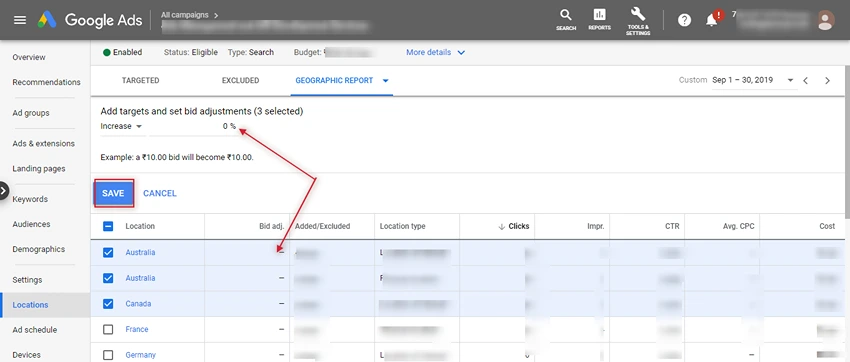
Did you know that the performance of each device, day of the week, time of day, and geographic location varies?You may run reports inside Google Ads based on these indicators to see where it makes sense to raise or reduce bids based on performance.To see device performance, go to the devices page and segment your campaigns or ad groups to view the performance of particular devices.
Seasonal trends
If you operate a seasonal company, your Google Ads performance will vary depending on the season.This might result in a decrease in conversion rates and an increase in the cost per conversion.The converse is also possible, such as during vacations. If your conversion rates may be much higher than typical, you should bid aggressively and grab as many conversions as feasible. After the holidays, however, when this performance is no longer expected, your offers should reflect this shift. Consider this while analyzing your account for seasonal patterns and determining how to best structure your bids to fulfil these demands.
Bidding rules
Google Ads enables you to define bidding rules that will halt, enable, and/or modify bids and/or budgets based on your criteria.Depending on your tab view inside Google Ads, you may define restrictions at the campaign, ad group, ad, and keyword levels.
Bidding scripts
Using Google Ads scripts, you may automate your Google Ads campaigns based on defined time intervals and other accessible data.Using scripts enables more customization than standard Google Ads rules since you may be really inventive with what you want to regulate. Such as modifying your offers depending on weather trends.
Google Ads bid adjustments
You may discover, for instance, that mobile devices generate conversions at a reduced cost. If so, it would make sense to increase bids by 20% on mobile devices for that particular campaign in order to increase volume.However, keep in mind that intelligent bidding methods are excellent at automatically detecting this and adjusting your offers appropriately.
Conclusion
Acquaint yourself with PPC reporting to position yourself for success since you may suspend or modify your campaign at any time. In addition, you should acquaint yourself with essential PPC data to identify opportunities for future improvement. You may also want to keep an eye out for annoying ad rejections that might prevent your campaign from launching. Aside from that, you’re fine to go. Try not to make adjustments more often than every two to thirty days, and for new campaigns, this interval may need to be much longer. So, chill down and absorb this incredible new Google Ads campaign you’ve created!You are now well-versed on how bidding works on Google Ads. You are also quite aware of the many sorts of bidding methods you might use and the pros and cons of each. In addition, you now have some helpful advice from us that will make your bid strategy choices even more successful.
