
Are your rankings where they should be, or is your SEO strategy falling short? With Google boasting over 200 critical ranking factors, understanding which elements truly impact search engine optimisation can seem overwhelming. Algorithm updates constantly shift these factors to improve search accuracy and relevance, leaving business owners and marketers striving to keep pace. In this blog post, Smarter Digital Marketing unpacks the complexity of Google’s ranking factors. Learn how these elements influence your website’s positioning and discover the key principles you need to succeed in the challenging world of SEO.
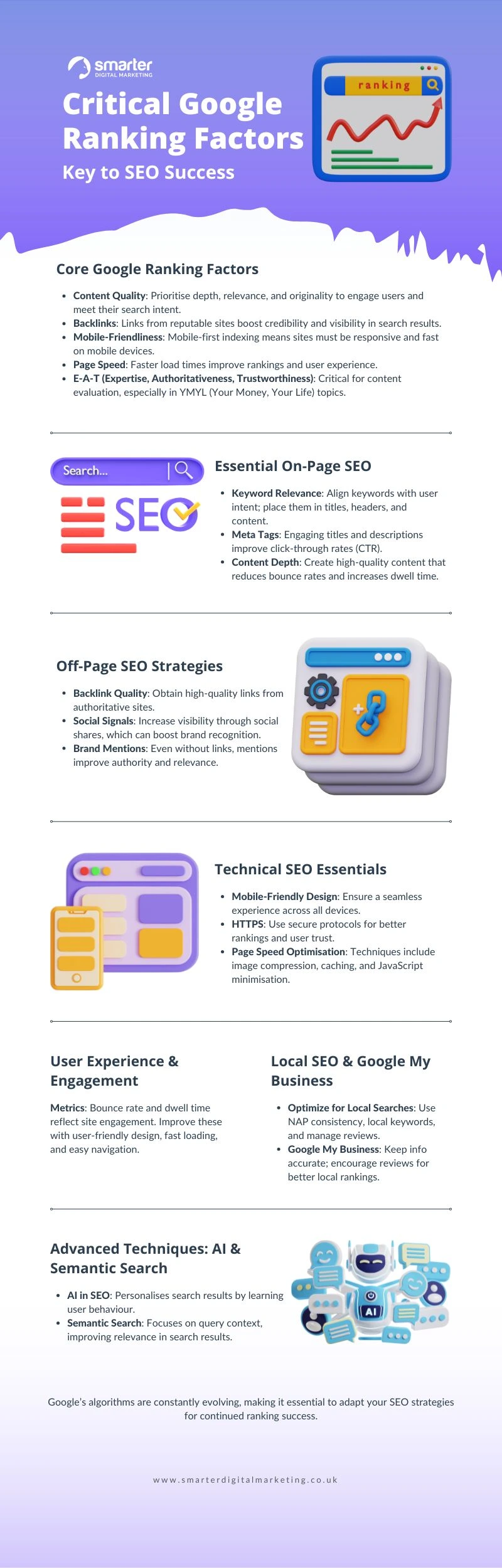 Critical Google Ranking Factors01″ width=”800″ height=”2500″ />
Understanding Critical Google Ranking Factors
Google’s ranking factors, numbering over 200, are pivotal in search engine optimisation (SEO). These factors determine a website’s visibility in search results, influencing user traffic and engagement. The complexity of these factors requires careful attention, as they assess various attributes including content quality, backlink profiles, and site usability. A website’s position in search results can significantly impact its digital presence, making an understanding of these factors crucial for businesses aiming to enhance their online visibility.
Algorithm updates continually reshape Google’s ranking criteria to ensure search results remain accurate and relevant. These updates reflect Google’s commitment to evolving user needs, emphasising the importance of adaptability in SEO strategies. As algorithms become more sophisticated, they enforce stricter guidelines for ranking, pushing websites to improve their digital offerings continually. Staying informed about these updates is essential for SEO professionals seeking to maintain or improve their site’s ranking position.
- Introduction of mobile-first indexing prioritises mobile usability.
- Emphasis on secure connections with HTTPS becoming a ranking factor.
- Increased importance of page speed for user experience and rankings.
- Incorporation of user engagement metrics, like dwell time.
- Greater focus on E-A-T (Expertise, Authoritativeness, Trustworthiness) in content evaluation.
On-Page SEO Techniques for Better Ranking
On-page SEO is critical in improving a website’s search engine ranking. It focuses on elements directly within the website, such as content quality, keyword relevance, and meta tags. These components must be meticulously optimised to align with user intent and search engine algorithms, ensuring that the website stands out in search results.
Content Quality
Content quality remains a cornerstone of successful on-page SEO. The relevance of the content to user queries is paramount, as it determines how well the content meets user needs. Depth and originality are crucial, as they differentiate your content from competitors, providing comprehensive insights that engage readers. High-quality content not only attracts visitors but also encourages them to engage, reducing bounce rates and improving dwell time.
Keyword Relevance
Selecting and incorporating keywords effectively is an art in itself. Keywords must be chosen based on a thorough understanding of search intent and competitive analysis. Their relevance to the content ensures that search engines can accurately index and rank the page. Proper keyword placement within titles, headings, and throughout the content enhances visibility, ensuring that the site appears in pertinent searches.
Meta Tags Effectiveness
The effectiveness of meta tags, including titles and descriptions, cannot be overstated. Well-optimised meta tags directly influence click-through rates by providing a succinct and enticing snapshot of the content. They also guide search engines in understanding the page’s primary focus, impacting how the page is indexed and ranked. Crafting precise and engaging meta tags can lead to significant improvements in search engine visibility.
| Technique | Effectiveness |
| Content Quality | High |
| Keyword Relevance | High |
| Meta Tags Effectiveness | Moderate |
Off-Page SEO Strategies: Backlinks and Beyond
Backlinks are a cornerstone of effective off-page SEO strategies. Why are backlinks so important for SEO? Backlinks from authoritative sites boost a website’s credibility and search engine ranking. They act as endorsements, signalling to search engines that the content is valuable and trustworthy. High-quality backlinks help improve a site’s visibility by linking it to relevant and reputable domains, thus enhancing its authority. Moreover, the diversity and relevance of these links are crucial, ensuring that the website is seen as a reliable source across various sectors.
Social signals and brand mentions further augment the impact of off-page SEO. Social signals refer to interactions on social media platforms that indicate a website’s popularity. These signals can indirectly influence search engine rankings by driving traffic and enhancing brand visibility. Brand mentions, even without direct links, contribute to a website’s online presence. They validate the site’s relevance within its industry, reinforcing its authority and trustworthiness in the digital landscape.
- Create high-quality, engaging content that naturally attracts backlinks.
- Build relationships with industry influencers for potential link opportunities.
- Utilise guest blogging on reputable sites to gain valuable backlinks.
- Monitor competitors’ backlink strategies to identify new opportunities.
Technical SEO Factors Influencing Google Rankings
Technical SEO is a foundational element in achieving higher search engine rankings, focusing on the optimisation of website infrastructure to enhance user experience and search engine understanding. Key technical aspects such as mobile-friendliness, page speed, and secure protocols are critical in aligning a website with Google’s ranking criteria.
Mobile-Friendliness
With Google’s mobile-first indexing, mobile-friendliness has become a paramount factor in SEO. This approach means Google predominantly uses the mobile version of a site for indexing and ranking. A mobile-friendly design ensures that users have a seamless experience across all devices, which is crucial as more users access sites from mobile devices. Responsive design, fast loading times, and easy navigation are essential components that contribute to mobile-friendliness, directly impacting a site’s visibility in search results.
Page Speed
Page speed significantly influences both user experience and search rankings. Fast-loading pages are favoured by users, leading to lower bounce rates and higher engagement. Google recognises this preference by prioritising sites with quick load times, as they provide a better user experience. Techniques to improve page speed include optimising images, leveraging browser caching, and minimising JavaScript. A faster site not only improves rankings but also enhances overall user satisfaction.
Secure Website Protocols
Implementing HTTPS is vital for securing user data and instilling trust. Google considers HTTPS as a ranking signal, favouring secure sites over non-secure ones. This protocol encrypts data exchanged between the user and the site, protecting sensitive information from interception. By adopting HTTPS, websites not only improve their SEO rankings but also enhance their credibility and user trust, which are crucial for long-term success.
- Google PageSpeed Insights
- Mobile-Friendly Test by Google
- Screaming Frog SEO Spider
User Experience: A Crucial Ranking Factor
How does user experience affect search engine rankings? The precision answer is that user experience impacts rankings through metrics like bounce rate and dwell time. These metrics serve as indicators of user engagement, reflecting the quality of interaction a visitor has with a website. A high bounce rate suggests that users leave the site quickly, often due to irrelevant content or poor site design. Conversely, a longer dwell time indicates that users find the content engaging and relevant, leading to extended visits. Search engines interpret these signals as indicators of a site’s value, influencing its ranking position accordingly.
Design elements play a pivotal role in enhancing user experience, directly impacting these engagement metrics. A user-friendly site design encourages longer visits and interaction by making navigation intuitive and content accessible. Key design improvements include optimising site navigation, ensuring fast page load times, and implementing a responsive design for mobile users. These elements not only improve the overall user experience but also contribute to better search rankings by meeting user expectations and reducing friction during site interaction.
- Simplified and intuitive site navigation
- Fast and efficient page load times
- Responsive design for seamless mobile access
The Role of Local SEO in Google Rankings

Local SEO plays a crucial role for businesses aiming to capture the attention of customers within specific regions. How does local SEO influence Google rankings? Precision dictates that by optimising for location-based searches, businesses can significantly improve their visibility in local search results. This involves tailoring content and strategies to meet the needs of local users, aligning with their search intent. Successfully implementing local SEO ensures that businesses appear prominently when users search for relevant services or products within their area, thus increasing the likelihood of attracting nearby customers.
Optimising Google My Business is a vital component of local SEO. How can businesses leverage Google My Business for local search success? The precision answer is that businesses must maintain accurate and up-to-date information, utilise relevant keywords, and encourage customer reviews. A well-optimised Google My Business profile enhances a business’s local search visibility by providing essential details such as location, operating hours, and customer feedback. This not only improves search rankings but also builds trust with potential customers, making it a key strategy for local SEO success.
- Ensure consistent NAP (Name, Address, Phone number) information across all platforms.
- Encourage and manage customer reviews to boost credibility.
- Use local keywords in business descriptions and posts.
Advanced SEO Techniques: Leveraging AI and Semantic Search
AI plays a transformative role in enhancing search result relevance by analysing user behaviour to personalise search experiences. How does AI improve search results? By employing machine learning algorithms, AI predicts user intent and preferences, ensuring that search engines deliver more accurate and tailored results. This process allows search engines to refine their understanding of user queries, adapting to individual needs and providing a more customised user experience. As AI continues to evolve, its ability to interpret complex data sets will further optimise search engine performance, making AI an indispensable component of advanced SEO strategies.
Semantic search significantly impacts content matching by focusing on the meaning behind user queries rather than just keywords. How does semantic search affect content matching? By examining the context and relationships between words, semantic search enhances the ability of search engines to deliver results that align closely with user intent. This approach ensures that content is not only relevant but also contextually appropriate, leading to higher user satisfaction and engagement. Semantic search’s emphasis on understanding natural language and context enables search engines to bridge the gap between user queries and content, elevating the precision of search results.
- Enhanced user engagement through personalised search results.
- Improved content relevance and accuracy in search engine results.
Final Words
Navigating the complexities of critical Google ranking factors can shape a company’s online success.
Throughout this article, the significance of on-page and off-page SEO techniques, alongside technical aspects and user experience, was discussed as central to effective search engine optimisation.
Embracing local SEO and advanced AI techniques further enhances digital presence.
With algorithm updates continually evolving, understanding these factors is crucial for maintaining competitive visibility and ensuring sustained growth.
Businesses that adapt and implement these strategies are poised to achieve higher rankings and increased online success.
If your site has been negatively impacted by algorithm changes, you may find our Guide To Google Penalty Recovery helpful for regaining your search visibility.
For agency support with this, see our PPC management and local SEO across Scotland and the UK.
FAQ
What are critical Google ranking factors?
Google’s ranking factors include over 200 elements that determine website positions in search results. These elements are crucial for search engine optimisation and adapt with algorithm updates to improve search accuracy.
How often do Google’s algorithm updates occur?
Google’s algorithm updates regularly to enhance search relevance. These updates modify the significance of ranking factors, making ongoing optimisation necessary for maintaining or improving search visibility.
What are the key changes in Google’s ranking factors over the past decade?
Key changes include a focus on mobile-friendliness, page speed, HTTPS security, content quality, and user experience metrics. These changes reflect evolving user and technological priorities in search engine optimisation.
How important is content quality for SEO?
Content quality plays a vital role in SEO by ensuring relevance, depth, and originality. High-quality content meets user intent, boosting search rankings by providing valuable information that satisfies user queries.
How should one choose and incorporate keywords effectively?
Choosing keywords involves researching user search behaviour to identify relevant terms. Incorporate these naturally into content, titles, and meta descriptions to improve visibility and relevance in search results.
What is the impact of well-optimised meta tags?
Well-optimised meta tags improve click-through rates by providing clear and compelling descriptions in search results. They enhance keyword relevance and ensure the content appears appealing to searchers.
Why are backlinks important for off-page SEO?
Backlinks from authoritative sites increase a website’s credibility and visibility. They indicate trustworthiness to search engines, contributing positively to search rankings and online reputation.
How do social signals affect search rankings?
Social signals such as shares, likes, and mentions enhance brand visibility and signal popularity. They influence a site’s credibility, indirectly impacting search rankings through increased traffic and engagement.
What makes mobile-friendliness essential for SEO?
Mobile-friendliness is essential due to Google’s mobile-first indexing policy. A mobile-optimised site ensures accessibility and usability on smartphones, improving user experience and search rankings.
How does page speed influence user experience and rankings?
Page speed significantly affects user experience by ensuring quick access to content. Faster loading times reduce bounce rates, leading to better user engagement and higher search rankings.
Why is HTTPS important for websites?
HTTPS ensures secure communication between the user and the website. It boosts trust and security, which are essential for protecting user data and maintaining a site’s credibility, impacting search rankings.
How do bounce rate and dwell time reflect user engagement?
Bounce rate and dwell time are key metrics reflecting user engagement. Lower bounce rates and extended dwell times generally indicate positive user experiences, influencing higher search rankings.
What role do design elements play in user experience?
Effective design elements enhance user experience by making navigation intuitive and content accessible. Well-designed interfaces encourage longer visits and interaction, contributing to favourable search rankings.
How can local SEO improve business visibility?
Local SEO targets location-based searches, increasing visibility for regional audiences. It uses tools like Google My Business to optimise local presence, crucial for businesses aiming to attract local customers.
What are tips for optimising Google My Business?
Optimise Google My Business by ensuring accurate business information, encouraging customer reviews, and posting updates regularly. These actions enhance local search visibility and engagement.
How does AI enhance search result relevance?
AI improves search relevance by analysing user behaviour and adjusting results accordingly. It aids in delivering personalised search experiences that match user intent closely with appropriate content.
What is the impact of semantic search on content matching?
Semantic search enhances content matching by understanding user query context and intent. It improves the accuracy of search results, ensuring that users find content that directly addresses their needs.
